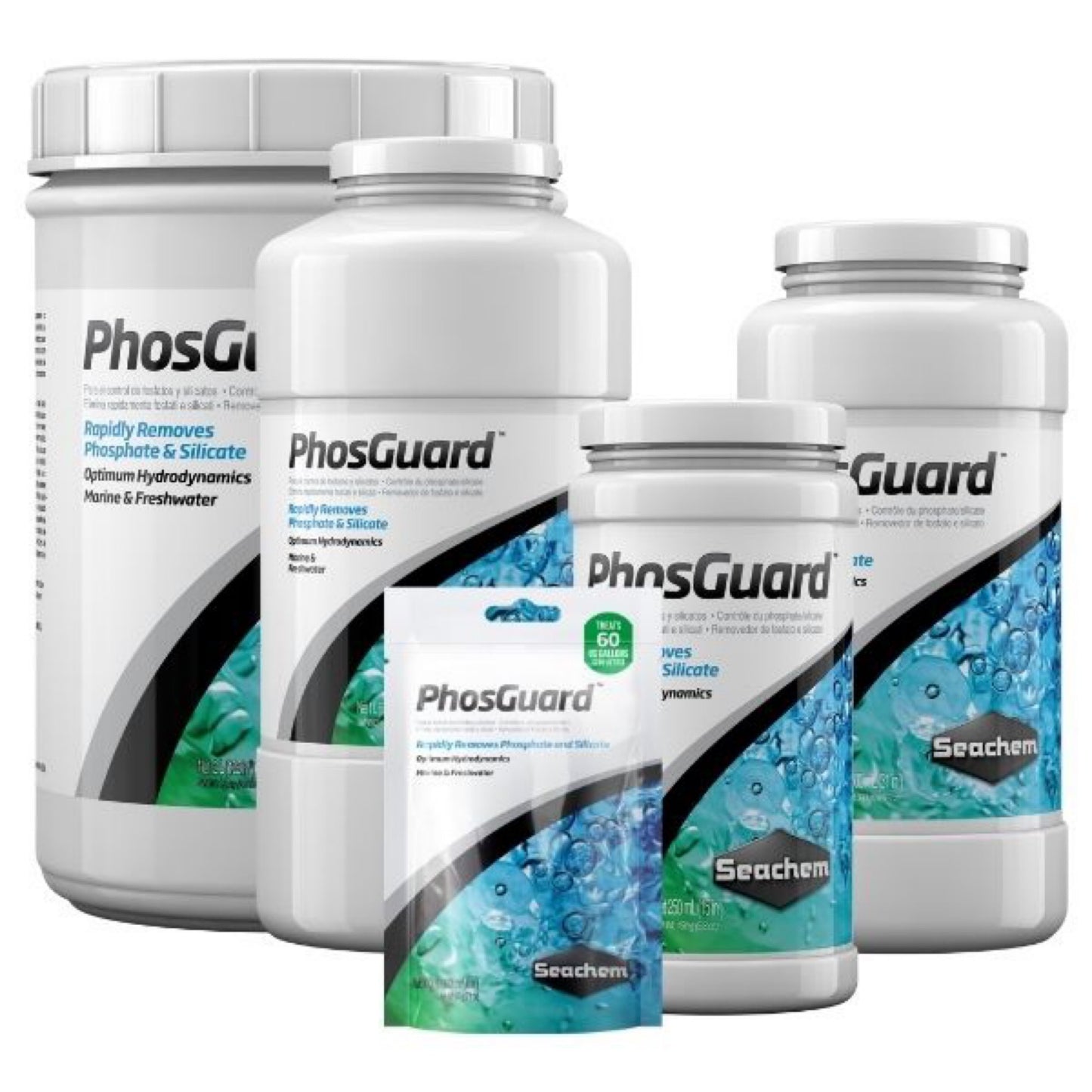
Seachem Phosguard
Seachem Phosguard
Low stock: 8 left
Couldn't load pickup availability
Product Description
PhosGuard™ rapidly removes phosphate and silicate from marine and freshwater aquariums. It is not recommended for phosphate-buffered freshwater. PhosGuard™ is highly porous for high capacity and bead-shaped for optimal water flow. It outperforms all competing products.
Why It’s Different
PhosGuard is spherical, allowing maximum water flow through the media. Granular phosphate removers can become compacted, dramatically limiting their capacity to remove phosphate. If the media cannot come into contact with the water, it cannot remove phosphate from it. PhosGuard is the only spherical phosphate remover on the market. Aluminum oxide is not regenerable. Baking aluminum oxide media does not restore its capacity to remove phosphate, despite claims to the contrary. This misconception comes from the product’s original intended use in industrial air drying. While baking can remove absorbed moisture, it does not remove the contaminants contained in that moisture.
Aluminum Oxide, Soluble Aluminum, and Coral Toxicity
In recent years, there has been speculation that aluminum oxide-based phosphate removers like PhosGuard™ release aluminum into the water and may damage corals. The evidence supporting this claim has largely been anecdotal.
We conducted a series of controlled experiments in both freshwater and saltwater to investigate aluminum solubility and toxicity. The results show that under reef conditions (a pH near 8), alumina releases no detectable soluble aluminum. Under low-pH conditions and at high dosage levels, soluble aluminum can be released from alumina. At three times the label dosage, we detected 0.2 mg/L of aluminum at a pH of 5.3.
Additionally, aluminum oxide is not easily absorbed into cells in a way that causes negative reactions. Even at three times the recommended dose of PhosGuard™, soft-bodied corals such as Sarcophyton remain unaffected.
Directions
For best results, place PhosGuard™ where water flow through the media is maximized. It may be used in a canister filter, box filter, or any high-flow area of a trickle filter. In some situations, it may be necessary to use a filter bag. Use 250 mL (approximately 1 cup) for every 300 L (75 gallons*). Leave the product in place for 4 days, then test phosphate or silicate concentrations with either MultiTest: Phosphate™ or MultiTest: Silicate™. If the concentration of the component you are trying to reduce has not dropped to around 0.02 mg/L, replace the PhosGuard. Otherwise, leave it in place until levels begin to climb again. As long as concentrations remain under control, the product is not exhausted. Each 500 mL of PhosGuard™ treats over 600 L (150 gallons*) (i.e., it will remove up to 30 mg/L of phosphate in 600 L [150 gallons*] of water), depending on the initial phosphate and silicate concentrations and the current biological load. Overdosing is not recommended. PhosGuard™ is not an exchange resin and does not release anything into the water. It does not leach phosphate or silicate back into the water. It may be removed, dried, and returned to service until exhausted. Continuous use of small quantities is better than intermittent use of larger quantities.
Caution: PhosGuard™ may generate heat on initial contact with water. Pre-wet it by adding it to twice its volume of freshwater (e.g., 250 mL of product in 500 mL of water), then rinse.
Shop now, pay later with 4 interest-free installments with AfterPay
Share